MomentumSignals
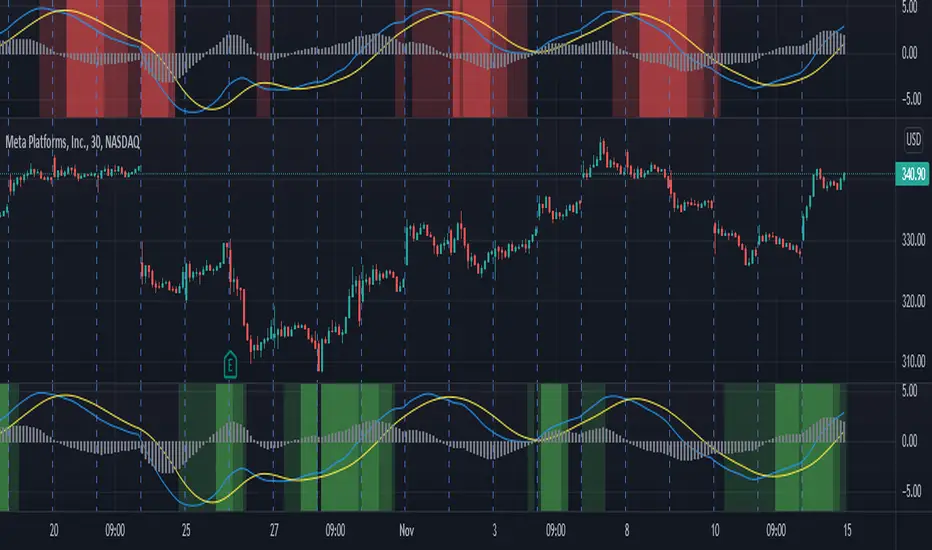
Contains utilities varying algorithms for detecting key changes in momentum. Note: Momentum is not velocity and should be used in conjunction with other indicators. A change in momentum does not mean a reversal of velocity or trend.
simple(primary, secondary, len) Compares two series for changes in momentum to derive signal values.
Parameters:
primary: The primary series (typically a moving average) to look for changes in momentum.
secondary: The secondary series (typically derived moving average of the primary) to use as a comparison value.
len: The number of bars to measure the change in momentum.
filtered(primary, secondary, len, stdlen, stdMultiple) Compares two series for changes in momentum to derive signal values. Uses statistics to filter out changes in momentum.
Parameters:
primary: The primary series (typically a moving average) to look for changes in momentum.
secondary: The secondary series (typically derived moving average of the primary) to use as a comparison value.
len: The number of bars to measure the change in momentum.
stdlen: The number of bars to measure the change in momentum for filtering.
stdMultiple: The multiple of the change in momentum to use before reversiing.
special(primary, secondary, stdlen, stdMultiple) Compares two series for changes in momentum to derive signal values. Uses statistics to filter out changes in momentum. Does not signal when likely overbought or oversold.
Parameters:
primary: The primary series (typically a moving average) to look for changes in momentum.
secondary: The secondary series (typically derived moving average of the primary) to use as a comparison value.
stdlen: The number of bars to measure the change in momentum for filtering.
stdMultiple: The multiple of the change in momentum to use before reversiing.
Added:
stochRSI(fast, fast, rsiLen, stochLen, src, kmode, upper, lower) Returns a signal value representing the stage of where the RSI is in its cycle.
Parameters:
fast: The length to average the stochastic.
fast: The length to smooth out K and produce D.
rsiLen: The length of the RSI.
stochLen: The length of stochastic.
src: The series to measure from. Default is 'close'.
kmode: The type of moving average to generate. Values allowed are: SMA, EMA, WMA, VWMA and VAWMA.
upper: The upper band of the range.
lower: The lower band of the range.
Returns: [K, D]
+1 oversold and rising
+2 rising above lower boundary
+3 rising above mid
+4 overbought
-1 overbought and falling
-2 falling above mid
-3 falling below upper boundary
-4 oversold
Updated:
stochRSI(smoothK, smoothD, rsiLen, stochLen, src, kmode, upper, lower) Returns a signal value representing the stage of where the RSI is in its cycle.
Parameters:
smoothK: The length to average the stochastic.
smoothD: The length to smooth out K and produce D.
rsiLen: The length of the RSI.
stochLen: The length of stochastic.
src: The series to measure from. Default is 'close'.
kmode: The type of moving average to generate. Values allowed are: SMA, EMA, WMA, VWMA and VAWMA.
upper: The upper band of the range.
lower: The lower band of the range.
Returns: [signal, stage] Where stage is: +1 is oversold and rising, +2 rising above lower bound but less than mid. +3 rising above mid. +4 is overbought. Negative numbers are the reverse.
Библиотека Pine
В истинном духе TradingView автор опубликовал этот код Pine как библиотеку с открытым исходным кодом, чтобы другие программисты Pine из нашего сообщества могли её использовать. Браво автору! Вы можете использовать эту библиотеку для личного пользования или в других публикациях с открытым исходным кодом, но повторное использование этого кода в публикациях регулируется Правилами поведения.

Отказ от ответственности
Библиотека Pine
В истинном духе TradingView автор опубликовал этот код Pine как библиотеку с открытым исходным кодом, чтобы другие программисты Pine из нашего сообщества могли её использовать. Браво автору! Вы можете использовать эту библиотеку для личного пользования или в других публикациях с открытым исходным кодом, но повторное использование этого кода в публикациях регулируется Правилами поведения.