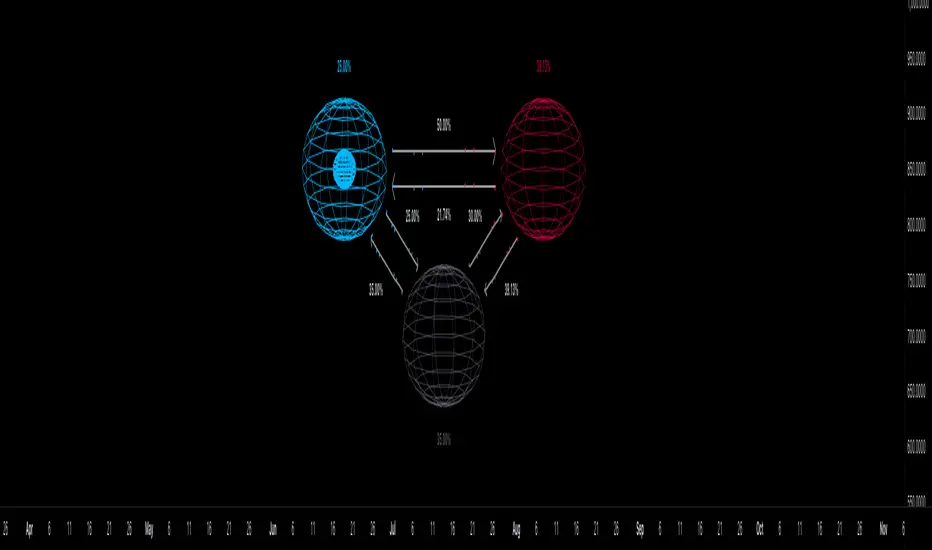
Hidden Markov Model: Regime Probability [AlgoPoint]Hidden Markov Model: Regime Probability
Traditional technical indicators are deterministic and lagging; they tell you what the price has already done. The Hidden Markov Model (HMM) Regime Probability system takes a completely different, quantitative approach. It uses probabilistic mathematics to estimate the unobservable "Hidden State" (Market Regime) the price is currently operating in.
Inspired by the mathematical models used by institutional quantitative hedge funds, this script doesn't just look at price direction—it calculates the probability of the market being in a specific regime based on real-time observations of Momentum and Volatility.
1. The Three Hidden States (Regimes)
The market is modeled as existing in one of three hidden states:
↗ Bullish Regime: High positive momentum with low or stable volatility. (Steady, grinding uptrends).
↘ Bearish Regime: High negative momentum with high volatility. (Aggressive sell-offs and panic).
↕ Chop / Chaos Regime: Zero/low momentum with high volatility. (Whipsaw, ranging, and unpredictable noise).
2. How It Works (The Quant Engine)
Since Pine Script does not natively support complex matrix optimization, this script builds a robust Pseudo-HMM using a predefined Transition Matrix and Bayesian Updates.
Observables (Emissions): The script calculates the Z-Scores of Smoothed Momentum (Rate of Change) and Volatility (ATR).
Emission Probabilities (Gaussian PDF): It feeds these Z-Scores into a Gaussian Probability Density Function to see how well the current market matches the expected profile of a Bull, Bear, or Chop regime.
Bayesian Update: Using a predefined Markov Transition Matrix (the statistical inertia of a trend), it updates the prior probabilities to give you a real-time percentage (0-100%) for each regime.
3. Advanced Visual Features & UI
We built a custom UI/UX engine to make digesting complex probabilities instantaneous:
Exponential Color Smoothing (Bar Colors): As the probability of a regime increases, the bar colors smoothly transition. We implemented an exponential color blending algorithm to prevent abrupt, distracting color changes and eliminate "muddy" colors during transitions.
Pro Quant Dashboard: A built-in HUD (Heads-Up Display) provides a quick summary. It features a dominant state readout, an overall "Confidence Score", and ASCII-style mini progress bars (████░░░) for rapid visual processing of probabilities without needing to read the numbers.
Stacked Area Oscillator: The bottom panel displays a 0-100 stacked area chart, showing the exact distribution of probabilities across Bull (Green), Chop (Purple), and Bear (Red) states.
4. How to Use This Tool
This is not a standalone Buy/Sell signal indicator. It is a Strategy Filter and a Risk Manager.
When Bull/Bear Probability is Dominant (>50%): The market is trending. Turn ON your trend-following indicators (like Moving Averages or Breakout systems) and ignore overbought/oversold signals.
When Chop Probability is Dominant (>50%): The market is noisy. Turn OFF your trend-following systems. Either switch to Mean Reversion strategies (like RSI or Bollinger Bands) or stay in cash until a clear regime emerges.
Watch the Confidence Score: If the Dashboard shows "LOW" confidence, it means the probabilities are split (e.g., 34% Bull, 33% Chop, 33% Bear). Wait for the model to gain confidence before committing capital.
5. Alerts
The script includes non-repainting alerts that trigger only when the dominant regime changes:
HMM Regime: BULLISH 🚀 * HMM Regime: BEARISH 🩸 * HMM Regime: CHOP ⚖️
6. Settings
Lookback Period: The window used to calculate the Z-scores for momentum and volatility.
Transition Matrix: Allows advanced users to tweak the statistical likelihood of the market staying in its current state versus transitioning to a new one.
Color Transition Speed: Adjusts the smoothness of the bar coloring. A lower value creates a buttery-smooth fade between regimes, while a value of 1.0 makes it instant.
Индикатор Pine Script®