What are long-term investments on a balance sheet?
Long-term investments are assets a company holds for more than a year, such as stakes in other companies, bonds, and loans it has made to others. On TradingView, the line is the sum of long-term notes receivable, investments in unconsolidated subsidiaries, and other investments. It shows how much of a company's capital sits outside its own operations, which helps explain income that doesn't come from its core business.
How are long-term investments calculated?
On TradingView, long-term investments are the sum of three lines:
Long-term investments = Long-term notes receivable + Investments in unconsolidated subsidiaries + Other investments
- Long-term notes receivable: Loans and other written promises of payment the company holds that fall due after more than a year, shown as note receivable - long term.
- Investments in unconsolidated subsidiaries: Stakes in companies the company influences but doesn't control, such as joint ventures, shown as investments in unconsolidated subsidiaries.
- Other investments: Shares and bonds of other companies, government securities, and similar holdings the company plans to keep beyond a year, shown as other investments.
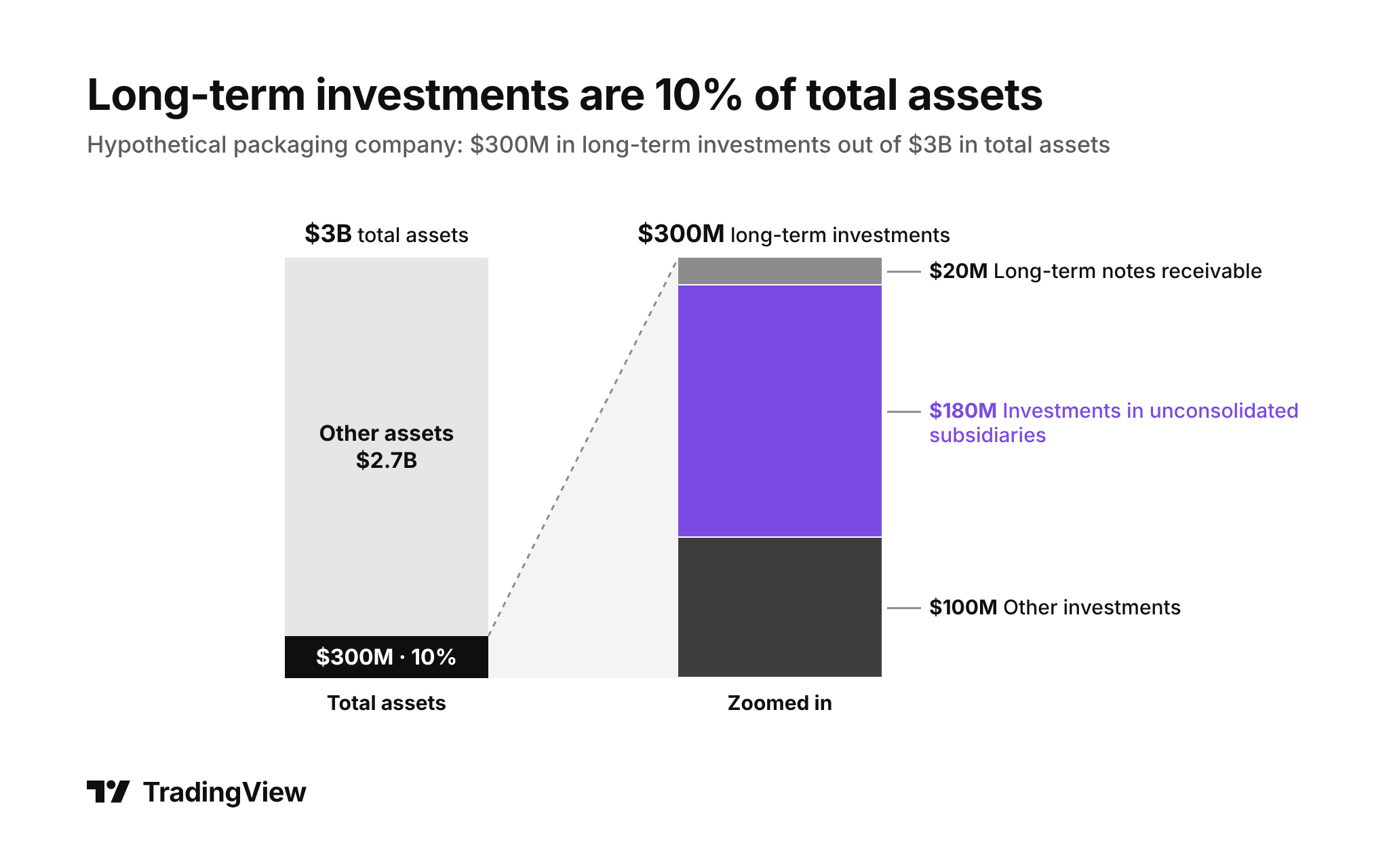
For example, a packaging company reports $3 billion in total assets at year-end. It holds a $20 million long-term loan to a supplier, a 35% stake in a recycling joint venture carried at $180 million, and $100 million in corporate bonds it plans to hold to maturity. Its long-term investments are $20 million + $180 million + $100 million = $300 million, or 10% of total assets.
Where do long-term investments sit on the balance sheet?
Long-term investments are part of total non-current assets, alongside net PP&E, intangible assets, deferred tax assets, and other long-term assets. Non-current assets and current assets together make up total assets.
How the investments are valued depends on the type of holding and the accounting standard:
- Equity method: A stake that gives significant influence, often 20%–50% of the voting shares, is carried at cost and then adjusted for the company's share of the investee's profit or loss.
- Fair value: Most smaller stakes in listed companies are measured at their market value on the reporting date under both US GAAP and IFRS.
- Amortized cost: Bonds and loans the company intends to hold to maturity are carried at their purchase cost adjusted over time toward the amount due.
The income from these holdings appears in the income statement, for example as equity in earnings from unconsolidated subsidiaries or as interest income.
How do long-term investments differ from short-term investments?
Long-term investments differ from short-term investments mainly in how long the company expects to hold them:
- Short-term investments: These are liquid holdings the company expects to sell or that mature within a year, such as Treasury bills or commercial paper. They're part of current assets and shown as short term investments, total.
- Long-term investments: These are held for more than a year, often for strategic reasons, such as access to a supplier or a market, or to earn a return over time.
The same bond can move between the lines. A five-year bond held as a long-term investment is reclassified as current when it has less than a year to maturity. Short-term investments are usually counted as part of a company's liquidity, while long-term investments usually aren't.
How are long-term investments interpreted?
Long-term investments are read through their size relative to total assets, their composition, and the income they produce. The balance sheet shows amounts on a single date, so compare the same reporting dates, such as year-end to year-end.
- Strategic stakes: A large investment in unconsolidated subsidiaries can reflect joint ventures or partnerships that matter to the business, even though their revenue and debt don't appear in the company's own figures.
- Return on the holdings: Comparing the income from investments with their carrying value shows whether the capital tied up in them earns a return.
- Sudden changes: A jump can reflect a new acquisition of a minority stake, while a drop can reflect a sale, a write-down, or a fall in market value.
Insurers and some other financial companies hold large investment portfolios as a core part of their business, and their balance sheets are presented differently from those of industrial companies.
What are the limitations of long-term investments?
Long-term investments combine holdings that are valued and reported in different ways:
- Mixed measurement: Some holdings are at market value, others at cost or under the equity method, so the total isn't a single estimate of what the investments are worth.
- Hidden obligations: The equity method shows only the company's share of an investee's net assets, not the investee's debt.
- Market swings: Holdings measured at fair value can move the line, and sometimes net income, without any change in the business.
- Limited detail: Companies disclose different levels of detail about what they hold, which makes comparisons between companies difficult.
Reading long-term investments together with non-operating income and the investment notes in a company's filings shows what the holdings are and what they contribute.
Exploring long-term investments with TradingView
TradingView shows long-term investments and their components in a company's balance sheet.
- Check long-term investments in a company's financials. Open the Financials section of a stock's symbol page and find the balance sheet, then compare the same reporting dates. Our guide on how to read financial statements explains the table.
- Plot balance sheet data on a chart. Fundamental metrics from a company's financial statements can be added to Supercharts. Each metric appears in a separate pane below the price chart and changes only when the company publishes a new report.
TradingView figures are standardized from company filings, so check the investment notes when the line changes sharply.